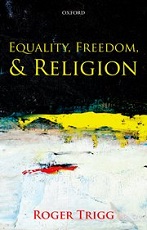
Equality, Freedom & Religion

Equality, Freedom & Religion

Roger Trigg. Equality, Freedom & Religion. Oxford: University Press; 2012 Jan 13, 224 pp. ISBN- 9780199576852.

Publisher’s Description
Is religious freedom being curtailed in pursuit of equality, and the outlawing of discrimination? Is enough effort made to accommodate those motivated by a religious conscience? All rights matter but at times the right to put religious beliefs into practice increasingly takes second place in the law of different countries to the pursuit of other social priorities. The right to freedom of belief and to manifest belief is written into all human rights charters. In the United States religious freedom is sometimes seen as ‘the first freedom’. Yet increasingly in many jurisdictions in Europe and North America, religious freedom can all too easily be ‘trumped’ by other rights.

Roger Trigg looks at the assumptions that lie behind the subordination of religious liberty to other social concerns, especially the pursuit of equality. He gives examples from different Western countries of a steady erosion of freedom of religion. The protection of freedom of worship is often seen as sufficient, and religious practices are separated from the beliefs which inspire them. So far from religion in general, and Christianity in particular, providing a foundation for our beliefs in human dignity and human rights, religion is all too often seen as threat and a source of conflict, to be controlled at all costs. The challenge is whether any freedom can preserved for long, if the basic human right to freedom of religious belief and practice is dismissed as of little account, with no attempt to provide any reasonable accommodation. Given the central role of religion in human life, unnecessary limitations on its expression are attacks on human freedom itself.
After-birth abortion: Why should the baby live?

Alberto Giubilini, Francesca Minerva

Journal of Medical Ethics

Abstract
Abortion is largely accepted even for reasons that do not have anything to do with the fetus’ health. By showing that (1) both fetuses and newborns do not have the same moral status as actual persons, (2) the fact that both are potential persons is morally irrelevant and (3) adoption is not always in the best interest of actual people, the authors argue that what we call ‘after-birth abortion’ (killing a newborn) should be permissible in all the cases where abortion is, including cases where the newborn is not disabled.


Giubilini A, Minerva F. After-birth abortion: Why should the baby live?. J Med Ethics. 2013;39(5):261-263.

Pediatricians’ experience with and response to parental vaccine safety concerns and vaccine refusals: a survey of Connecticut pediatricians

Susan Leib, Penny Liberatos, Karen Edwards

Public Health Reports

Abstract
Objectives
. Physicians are seeing increasing numbers of parents who question the safety of vaccines or refuse to vaccinate their children. This study examined how frequently pediatricians in one New England state encounter parental vaccine safety concerns and vaccine refusals, how often physicians dismiss families from their practices for vaccine refusal, and how parental vaccine refusal impacts pediatricians personally.

Methods. The study consisted of a quantitative survey of primary care pediatri-cians in one New England state; 133 pediatricians completed the questionnaire. Variables examined included number of parental vaccine concerns and refusals seen by each physician, physicians’ response to parental vaccine concerns and refusals, the personal impact of parental vaccine safety refusals on pediatricians, and respondent estimates of socioeconomic characteristics of families seen in their practices.

Results. The majority of responding pediatricians reported an increase in parental vaccine safety concerns and refusals. More than 30% of responding pediatricians have dismissed families because of their refusal to immunize. Suburban physicians caring for wealthier, better educated families experience more vaccine concerns and/or refusals and are more likely to dismiss families for vaccine refusal. Vaccine refusals have a negative personal impact on one-third of physician respondents.

Conclusions. Pediatricians in Connecticut are reporting increased levels of parental vaccine safety concerns and refusals. Physicians who report more parental vaccine safety concerns and refusals and who care for wealthier, better educated families are more likely to dismiss families who refuse vaccines and to be negatively affected by parental vaccine refusals, which may adversely impact childhood vaccination rates.


Leib S, Liberatos P, Edwards K.  Pediatricians’ experience with and response to parental vaccine safety concerns and vaccine refusals: a survey of Connecticut pediatricians. Public Health Rep. 2011 Jul-Aug;126 Suppl 2:13-23

Revalidation of the perceptions of conscience questionnaire (PCQ) and the stress of conscience questionnaire (SCQ)

Johan Ahlin, Eva Ericson-Lidman, Astrid Norberg, Gunilla Strandberg

Nursing Ethics
Nursing Ethics

Abstract
The Perceptions of Conscience Questionnaire (PCQ) and the Stress of Conscience Questionnaire (SCQ) have previously been developed and validated within the ‘Stress of Conscience Study’. The aim was to revalidate these two questionnaires, including two additional, theoretically and empirically significant items, on a sample of healthcare personnel working in direct contact with patients.The sample consisted of 503 healthcare personnel.To test variation and distribution among the answers, descriptive statistics, item analysis and principal component analysis (PCA) were used to examine the underlying factor structure of the questionnaires.Support for adding the new item to the PCQ was found.No support was found for adding the new item to the SCQ. Both questionnaires can be regarded as valid for Swedish settings but can be improved by rephrasing some of the PCQ items and by adding items about private life to the SCQ.


Ahlin J, Ericson-Lidman E, Norberg A, Strandberg G. Revalidation of the perceptions of conscience questionnaire (PCQ) and the stress of conscience questionnaire (SCQ). Nurs Ethics. 2012;19(2):220-232.

Conscience Rules: Implications for Care

Ryan Blum

The Hastings Center Report

Extract
On February 18, the Department of Health and Human Services issued a rule, “Regulation for the Enforcement of Federal Health Care Provider Conscience Protection Laws,” that limits health care providers’ power to shape their practice by personal conviction. The rule narrows possible conscientious objection significantly, protecting patients’ rights and in the process eliminating public reinforcement of the harmful idea that religion and medicine are always destined to diverge.


Blum R. Conscience Rules: Implications for Care. Hastings Cent Rep 2011;41(3):c3.

What makes killing wrong?

Walter Sinnott-Armstrong, Franklin G Miller

Journal of Medical Ethics

Abstract
What makes an act of killing morally wrong is not that the act causes loss of life or consciousness but rather that the act causes loss of all remaining abilities. This account implies that it is not even pro tanto morally wrong to kill patients who are universally and irreversibly disabled, because they have no abilities to lose. Applied to vital organ transplantation, this account undermines the dead donor rule and shows how current practices are compatible with morality.


Sinnott-Armstrong W, Miller FG. What makes killing wrong? J Medical Ethics 2013;39:3-7.

(Correspondence) Should doctors feel able to practise according to their personal values and beliefs?

Murat Civaner

The Medical Journal of Australia

Extract
The moral problem related to defining a space for personal values in medical care is that they may conflict with professional values, legitimising discrimination. Then it would be nearly impossible to criticise doctors and institutions that refuse abortion, do not examine patients of the opposite sex on religious grounds, and refuse to operate on HIV-positive patients or to treat people with different political affiliations. It would be hard to call that kind of environment a “healthy diversity”.


Civaner M. (Correspondence) Should doctors feel able to practise according to their personal values and beliefs?. Med J Aust. 2012 Feb 06;196(2):109.

(Correspondence) Should doctors feel able to practise according to their personal values and beliefs?

William R Adam

The Medical Journal of Australia

Extract

Clinicians have to be prepared to go to court to put their case for the best interests of the child, and then accept the legal decision with good grace, however personally distressing. This is just another example in medicine of the need for all to work with less than desirable outcomes.


Adam WR. (Correspondence) Should doctors feel able to practise according to their personal values and beliefs? Med J Aust. 2012;196(2):109.

The Harmony Between Professional Conscience Rights and Patients’ Right of Access

Matthew S Bowman, Christopher P Schandevel

Social Science Research Network

Abstract
“Access” is the new catchphrase for expanding privacy rights. This shift moves from seeking merely legalization, to demanding government assistance and the participation of private citizens. . . . This article will begin by examining the chief access arguments being used against conscience protections today: that the health professionals hold a monopoly so they are bound to offer abortion, that health professionals must defer their pro-life consciences to abortion’s legal status, and that health professionals must not impose their pro-life views. The article will conclude that, if access principles really flowed from a neutral concern for patient choices, they would require rather than strike down conscience protections. In many cases patients desire in their physicians the traditional Hippocratic values that unequivocally support human life and therefore oppose participating in activities such as abortion. The right of patients to access such physicians can only exist by guaranteeing the right of physicians to practice according to those values.


Bowman MS, Schandevel CP. The Harmony Between Professional Conscience Rights and Patients’ Right of Access. Social Science Research Network. 2012;1-39.

Best evidence in critical care medicine. Early versus late parenteral nutrition in the adult ICU: feeding the patient or our conscience?

Jeff P Kerrie, Sean M Bagshaw, Peter G Brindley

Canadian Journal of Anesthesia

Abstract
Background:
Critical illness increases the risk of malnutrition, which can increase infections, prolong mechanical ventilation, delay recovery, and increase mortality. While enteral nutrition (EN) is considered optimal, this is not always an option. Furthermore, algorithms for parenteral nutrition (PN) vary significantly, and it is unclear whether early initiation or delay of parenteral feeding is preferable.

Objective: This study compares intensive care unit (ICU) duration of stay in adults randomized to early initiation of PN (within 48 hr of ICU admission) vs delayed (at eight days or later after ICU admission), as consistent with European and North American guidelines, respectively. . . .

Conclusions: While ICU and 90-day survival were not significantly different, patients in the late PN group were discharged earlier from both the ICU and the hospital. Late PN initiation was also associated with fewer infections, shorter mechanical ventilation time, shorter RRT time, and lower overall healthcare costs. While there were more episodes of hypoglycemia and more inflammation in the late PN group, there was no apparent clinical consequence. No primary or secondary end points showed that early PN was superior.


Kerrie JP, Bagshaw SM, Brindley PG. Best evidence in critical care medicine. Early versus late parenteral nutrition in the adult ICU: feeding the patient or our conscience? Can J Anesthesia. 2012 Feb 03;59(5):494-498.