Abstract Debate persists over the place of conscience in medicine. Some argue for the complete exclusion of conscientious objection, while others claim an absolute right of refusal. This paper proposes that claims of conscientious objection can and should be permitted if they concern kinds of actions which fall outside of the normative standard of medicine, which is the pursuit of health. Medical practice which meets this criterion we call medicine qua medicine. If conscientious refusal concerns something consonant with the health-restoring aims of medicine, it entails a desertion of professional duty. If, however, it relates to something other than medicine qua medicine, it can rightly be refused. It thus becomes possible to test instances of conscientious objection to determine their validity, and thereby conserve both the principle of conscientious objection and define its scope. This test of conscience prevents arbitrary discrimination, and preserves doctors’ agency. It is a theoretical razor rooted in the practical reasoning of medicine whose operation will prompt, if nothing else, reflection on the goals of medicine.
Joseph K. Canner, Omar Harfouch, Lisa M Kodadek, Danielle Pelaez, Devin Coon, Anaeze C Offodile II, Adil H. Haider, Brandyn D Lau
Journal of the American Medical Association
Abstract Importance:Little is known about the incidence of gender-affirming surgical procedures for transgender patients in the United States.
Objectives:To investigate the incidence and trends over time of gender-affirming surgical procedures and to analyze characteristics and payer status of transgender patients seeking these operations.
Design, Setting, and Participants: In this descriptive observational study from 2000 to 2014, data were analyzed from the National Inpatient Sample, a representative pool of inpatient visits across the United States. The initial analyses were done from June to August 2015. Patients of interest were identified by International Classification of Diseases, Ninth Revision, diagnosis codes for transsexualism or gender identity disorder. Subanalysis focused on patients with procedure codes for surgery related to gender affirmation.
Main Outcomes and Measures: Demographics, health insurance plan, and type of surgery for patients who sought gender-affirming surgery were compared between 2000-2005 and 2006-2011, as well as annually from 2012 to 2014.
Results; This study included 37 827 encounters (median [interquartile range] patient age, 38 [26-49] years) identified by a diagnosis code of transsexualism or gender identity disorder. Of all encounters, 4118 (10.9%) involved gender-affirming surgery. The incidence of genital surgery increased over time: in 2000-2005, 72.0% of patients who underwent gender-affirming procedures had genital surgery; in 2006-2011, 83.9% of patients who underwent gender-affirming procedures had genital surgery. Most patients (2319 of 4118 [56.3%]) undergoing these procedures were not covered by any health insurance plan. The number of patients seeking these procedures who were covered by Medicare or Medicaid increased by 3-fold in 2014 (to 70) compared with 2012-2013 (from 25). No patients who underwent inpatient gender-affirming surgery died in the hospital.
Conclusions and Relevance: Most transgender patients in this national sample undergoing inpatient gender-affirming surgery were classified as self-pay; however, an increasing number of transgender patients are being covered by private insurance, Medicare, or Medicaid. As coverage for these procedures increases, likely so will demand for qualified surgeons to perform them.
Extract Patients’ rights to access to medical assistance in dying (MAiD) trumps the religious rights of physicians under the Canadian Charter of Rights and Freedoms – or so says the Ontario Superior Court of Justice. But ensuring equitable access to health care is a societal responsibility and does not rest solely on the individual physician. Surely there is a way forward that ensures access for patients requesting MAiD without trampling on physician rights enshrined in law.
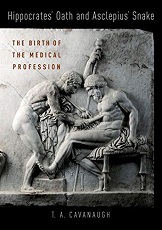
Thomas A. Cavanagh. Hippocrates’ Oath and Asclepius’ Snake:The Birth of the Medical Profession. New York: Oxford University Press, 2018. 177 pp.
Publisher’s Description T. A. Cavanaugh’s Hippocrates’ Oath and Asclepius’ Snake: The Birth of the Medical Profession articulates the Oath as establishing the medical profession’s unique internal medical ethic – in its most basic and least controvertible form, this ethic mandates that physicians help and not harm the sick. Relying on Greek myth, drama, and medical experience (e.g., homeopathy), the book shows how this medical ethic arose from reflection on the most vexing medical-ethical problem – injury caused by a physician – and argues that deliberate iatrogenic harm, especially the harm of a doctor choosing to kill (physician assisted suicide, euthanasia, abortion, and involvement in capital punishment), amounts to an abandonment of medicine as an exclusively therapeutic profession. The book argues that medicine as a profession necessarily involves stating before others what one stands for: the good one seeks and the bad one seeks to avoid on behalf of the sick, and rejects the view that medicine is purely a technique lacking its own unique internal ethic. It concludes noting that medical promising (as found in the White Coat Ceremony through which U. S. medical students matriculate) implicates medical autonomy which in turn merits respect, including honoring professional conscientious objections.
Abstract The aim of this article is to use data from Belgium to analyse distinctions between palliative sedation and euthanasia. There is a need to reduce confusion and improve communication related to patient management at the end of life specifically regarding the rapidly expanding area of patient care that incorporates a spectrum of nuanced yet overlapping terms such as palliative care, sedation, palliative sedation, continued sedation, continued sedation until death, terminal sedation, voluntary euthanasia and involuntary euthanasia. Some physicians and nurses mistakenly think that relieving suffering at the end of life by heavily sedating patients is a form of euthanasia, when indeed it is merely responding to the ordinary and proportionate needs of the patient. Concerns are raised about abuse in the form of deliberate involuntary euthanasia, obfuscation and disregard for the processes sustaining the management of refractory suffering at the end of life. Some suggestions designed to improve patient management and prevent potential abuse are offered.
G. Bravo, C. Rodrigue, M. Arcand, J. Downie, M.-F. Dubois, S. Kaasalaine, C.M. Hertogh,S. Pautex, L. Van den Block
Geriatric Nursing
Abstract We conducted a survey in a random sample of 514 Quebec nurses caring for the elderly to assess their attitudes towards extending medical aid in dying to incompetent patients and to explore associated factors. Attitudes were measured using clinical vignettes featuring a hypothetical patient with Alzheimer disease. Vignettes varied according to the stage of the disease (advanced or terminal) and the presence or absence of a written request. Of the 291 respondents, 83.5% agreed with the current legislation that allows physicians to administer aid in dying to competent patients who are at the end of life and suffer unbearably. A similar proportion (83%, p = 0.871) were in favor of extending medical aid in dying to incompetent patients who are at the terminal stage of Alzheimer disease, show signs of distress, and have made a written request before losing capacity.
Sigrid Dierickx, Luc Deliens, Joachim Cohen, Kenneth Chambaere
Palliative Medicine
Abstract Background: In the international debate about assisted dying, it is commonly stated that euthanasia is incompatible with palliative care. In Belgium, where euthanasia was legalized in 2002, the Federation for Palliative Care Flanders has endorsed the viewpoint that euthanasia can be embedded in palliative care.
Aim: To examine the involvement of palliative care services in euthanasia practice in a context of legalized euthanasia.
Setting/participants: Physicians attending a random sample of 6871 deaths in Flanders, Belgium, in 2013.
Results: People requesting euthanasia were more likely to have received palliative care (70.9%) than other people dying non-suddenly (45.2%) (odds ratio = 2.1 (95% confidence interval, 1.5–2.9)). The most frequently indicated reasons for non-referral to a palliative care service in those requesting euthanasia were that existing care already sufficiently addressed the patient’s palliative and supportive care needs (56.5%) and that the patient did not want to be referred (26.1%). The likelihood of a request being granted did not differ between cases with or without palliative care involvement. Palliative care professionals were involved in the decision-making process and/or performance of euthanasia in 59.8% of all euthanasia deaths; this involvement was higher in hospitals (76.0%) than at home (47.0%) or in nursing homes (49.5%).
Conclusion: In Flanders, in a context of legalized euthanasia, euthanasia and palliative care do not seem to be contradictory practices. A substantial proportion of people who make a euthanasia request are seen by palliative care services, and for a majority of these, the request is granted.
Andrea L. Murphy, Claire O’Reilly, Ruth Martin-Misener, Randa Ataya, David Gardner
Canadian Pharmacists Journal
Extract Conclusion Pharmacists are likely underestimating their frequency of interactions with people with thoughts of dying or with intentions to die either by suicide or through medical assistance in dying procedures. Pharmacists report empathetic responses for those with severe and incurable diseases wishing to end their life, but most do not support death by suicide or through medical assistance. From the preliminary analysis, a personal connection to mental illness or suicide does not appear to influence the permissiveness of pharmacists’ attitudes towards suicide. Framing effects in survey research for pharmacists have not been adequately considered, and more work is needed to determine how this influences the responses of pharmacists.
Louise P King, Rachel L Zacharias, Josephine Johnston
The Hastings Center Report
Abstract Respect for autonomy is a central value in reproductive ethics, but it can be a challenge to fulfill and is sometimes an outright puzzle to understand. If a woman requests the transfer of two, three, or four embryos during fertility treatment, is that request truly autonomous, and do clinicians disrespect her if they question that decision or refuse to carry it out? Add a commitment to justice to the mix, and the challenge can become more complex still. Is it unfair for insurance policies to exclude from coverage the costs of giving fertility to those who lack it or restoring fertility in those who have lost it? What does “just reproduction” look like in the face of multifarious understandings of both justice and autonomy and in light of increasingly complex and costly reproductive technologies? In today’s dialogue about reproduction, medicine, and ethics in the United States, old ethical issues—such as whether women ought to be allowed to access pregnancy termination—are more contested than they have been in decades, while new technologies—like those used to edit the genes of human embryos—suggest that our species could face unprecedented questions about who should exist. As we considered the discussions accompanying these issues and contemplated a special report responding to them, we found ourselves consistently circling back to two ethical commitments: respect for autonomy and the pursuit of justice. As one of the nine essays in this collection asks, why should certain women receive help to establish a pregnancy while others are thrown in jail when they miscarry or their child is stillborn? Respect for autonomy is required where individuals have the ability to make fully informed and voluntary choices. Yet does respecting autonomy require acceding to all the choices of patients or consumers of medical care? We consider these and related questions in this special report from the Hastings Center Report..
Eli Xavier Bator, Bethany Philpott, Andrew Paul Costa
BMC Medical Ethics
Abstract Background: In February, 2015, the Supreme Court of Canada struck down the ban on medical assistance in dying (MAiD). In June, 2016, the federal government passed Bill C-14, permitting MAiD. Current medical students will be the first physician cohort to enter a system permissive of MAiD, and may help to ensure equitable access to care. This study assessed medical student views on MAiD, factors influencing these views, and opportunities for medical education. Methods: An exploratory cross-sectional survey was developed and distributed to medical students across all years of a three-year Canadian undergraduate medical program. The investigators administered the survey to participants during academic sessions from November to December, 2015. Analysis of the results included summary descriptive statistics, Pearson’s chi-square test of independence to identify differences between participants by year of study, logistic regression to identify factors that influence students’ stances on MAiD, and Wilcoxon signed rank test to measure changes in student support for MAiD and comfort discussing MAiD. Results: There were 405 participants for a response rate of 87%. The majority of students (88%) supported the Supreme Court’s decision, 61% would provide the means for a patient to end their life, and 38% would personally administer a lethal medication. Students who were more willing to provide the means for MAiD found medical education/clinical experience and patient autonomy to be important contributors to their stances on MAiD. Those students who were less willing to provide the means for MAiD found religious/spiritual beliefs and teachings, as well as concern about potential negative consequences, to be important contributors to their stances on MAiD. Educational training desired by participants included medicolegal (91%), communication skills (80%), technical skills (75%), and religious (49%). Conclusions: Medical students generally supported and would provide the means for MAiD to patients. They also indicated a desire for directed medical education on MAiD.