
(Correspondence) “Universal” moral principles

Wendell W Watters

Canadian Medical Association Journal, CMAJ
Canadian Medical Association Journal

Extract
Apart from such simple principles as the Golden Rule and the Greatest Good for the Greatest Number of People, what universal moral principles are there? Apparently Lemoine’s value system would compel unwilling pregnant women to become mothers against their will (the view of the Roman Catholic Church and other antichoice groups); this is in direct opposition to the position that couples should be allowed to regulate their own reproductivity, the view of the United Nations declaration on family planning, to which Canada was a signatory. Neither of these moral positions is universal or based on absolutes. The first arose out of the Christian Church’s desire to implement policies of demographic aggression against all other groups. The second arose in this century out of our collective appreciation that such policies may spell extinction for all forms of life on this planet. Many of the bloodiest episodes in history came about as a result of one group’s seeking to impose “universal” moral principles on others.


Watters WW. (Correspondence) “Universal” moral principles. Can Med Assoc J. 1989 May 01;140(9):1016.
(Correspondence) Abortion

Philip E Shea

Canadian Medical Association Journal, CMAJ
Canadian Medical Association Journal

Extract
In his article “Abortion: The CMA’s new policy is a good one” (Can Med AssocJ 1988; 139: 991) Dr. John Lamont misinterprets the Catholic Church’s constant moral teaching on this critical issue. The misinformation could promote prejudice against Catholics who uphold the traditional doctrine that abortion at any stage is a serious sin against God, the creator of all human life. Lamont’s pontifical reference could not have been authenticated by a qualified Catholic scholar.


Shea PE. (Correspondence) Abortion. Can Med Assoc J. 1989 Apr 1;140(7):789.

(Correspondence) L’avortement

Paul de Bellefeuille

Canadian Medical Association Journal, CMAJ
Canadian Medical Association Journal

Extract
[Translation] It is obvious that the policy does not appeal to the majority of physicians. They would prefer a regime where the life and health of the child are respected and protected in the same way as those of the mother. It is not about a choice between the two.


de Bellefeuille P. (Correspondence) L’avortement. Can Med Assoc J. 1989;140(6):585-586.

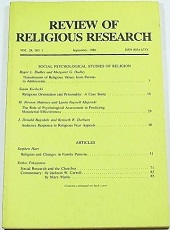
Ecumenism and Abortion: A Case Study of Pluralism, Privatization and Public Conscience

James Kelly

Review of Religious Research

Abstract
This paper uses the Churches’ responses to the controversy over abortion as a measure of the internalization of ecumenism. The data used in the essay include interviews with ecumenical officers and the minutes of the American Bishops Pro-life Committee. The main conclusion is that during the controversy “mainstream” Protestantism and Roman Catholicism reverted to post-Reformation and pre-Vatican II ideological roles, with Catholicism opposing under the banner of objective moral truth the legalization of abortion and liberal Protestantism under the banner of subjective conscience providing a belated religious justification to the legalization promoted first by secularist activists. This reversal to historic ideological roles actually distorted the more nuanced positions of these Churches in the controversy, but the lack of an ecumenical context obscured these shared tensions and prevented the Churches from contributing to a better public structuring of the moral ambiguities most Americans felt and still experience about abortion and the extent of its legalization. The essay concludes that only in an ecumenical context can religious pluralism lead to more inclusive moral commitments rather than to a further privatization of religion.


Kelly J. Ecumenism and Abortion: A Case Study of Pluralism, Privatization and Public Conscience. Rev Relig Res. 1989 Mar;30(3):225-235.

(Correspondence) Potential danger

Philip C Cody

Canadian Medical Association Journal, CMAJ
Canadian Medical Association Journal

Extract
Rapp is using words in an incorrect way to hide from himself what is happening. An oak (or any seed) dies and the germ plasm begins to develop. A fetus is already growing and developing and, if Rapp wishes an analogy, is like a seedling.


Cody PC. (Correspondence) Potential danger. Can Med Assoc J. 1989 Jan 15;140(2):105.

When caesarian section operations imposed by a court are justified

Eike-Henner Kluge

Journal of Medical Ethics

Abstract
Court-ordered caesarian sections against the explicit wishes of the pregnant woman have been criticised as violations of the woman’s fundamental right to autonomy and to the inviolability of the person-particularly, so it is argued, because the fetus in utero is not yet a person. This paper examines the logic of this position and argues that once the fetus has passed a certain stage of neurological development it is a person, and that then the whole issue becomes one of balancing of rights: the right-to-life of the fetal person against the right to autonomy and inviolability of the woman; and that the fetal right usually wins.


Kluge E-H. When caesarian section operations imposed by a court are justified. J Med Ethics. 1988 Dec;14(4) 206-211.

Abortion: the issue the CMA has refused to address is life

David Knickle

Canadian Medical Association Journal, CMAJ
Canadian Medical Association Journal

Extract
The CMA’s new statement shifts the balance very heavily away from the sanctity of human life and places more emphasis on these pregnancy-related problems. Surely this is contrary to our traditional medical ethic of protecting life and curing disease. . .

The issue for our profession should be this: What is medically acceptable? We must set our standards of ethical practice. Surely we are capable of defining what is therapeutic and what is non- therapeutic in life-and-death situations. The issue here is not whether we are pro-choice or pro-life, or for or against abortion on demand. The issue is simply whether we will hold to our traditional medical ethic of protecting life and treating disease.


Knickle D. Abortion: the issue the CMA has refused to address is life. Can Med Assoc J. 1988 Nov 15;139(10):990.

(Correspondence) The CMA’s position on abortion

R Lee Isaacs

Canadian Medical Association Journal, CMAJ
Canadian Medical Association Journal

Extract
Well! The CMA has certainly done the “in” thing with its resolution on abortion. . . It has never been traditional or ethical to prescribe according to the demands of the patient, whether for narcotics or for euthanasia or for abortion. Minds can change, but death is final. The resolution portrays abandonment of principle, not leadership.


Isaacs RL. (Correspondence) The CMA’s position on abortion. Can Med Assoc J. 1988 Nov 15;139(10):929.

(News) Abortion issue dominates NBMS annual meeting

Lucian Blair

Canadian Medical Association Journal, CMAJ
Canadian Medical Association Journal

Extract
The NBMS Board of Directors adopted an abortion policy that stated: “The issue of abortion is a personal one between the patient and the physician governed by individual conscience and the law of the land.” . . . Following a protracted and impassioned debate, the statement was adopted. Feelings were running so high that in one case an NBMS member asked another doctor if he wished to “step outside” to discuss the issue.


Blair L. Abortion issue dominates NBMS annual meeting. Can Med Assoc J. 1988;139(8):797.

(News) Women doctors favour time-dependent rules on abortion, survey reveals

Patrick Sullivan

Canadian Medical Association Journal, CMAJ
Canadian Medical Association Journal

Extract
The survey, which attracted responses from 443 women physicians, found that 60.3% of respondents favoured abortion without restrictions during the first trimester of a pregnancy . . 28.6% for the second trimester, and . . . 3% for pregnancies that had lasted more than 20 weeks. . . .the number . . . wanting some restrictions jumped from 37.4% for the first trimester . . . to 62.9% for the second and 64.6% for the third. Only small fractions of FMWC members – 1.4% and 2.8%, respectively – were opposed to abortion for any reason during the first two trimesters. However, this jumped to 27.1% for pregnancies that had lasted longer than 20 weeks.


Sullivan P. Women doctors favour time-dependent rules on abortion, survey reveals. Can Med Assoc J. 1988;139(7):669-670.